
FOR UNIVERSITY CATERING
More access. Less food wasted.
A busy campus isn’t equally busy every day. Food Be Good organises the collection of suitable surplus after regular service, with a limited participant group and a process that fits your canteen.
Discuss a setup for our siteFOR YOUR ADDITIONAL SERVICE
From five minutes a day.
Fixed compensation.
Paid in advance.
Redistribute suitable surplus after regular service. Additional serving time starts at five minutes a day. Your canteen receives fixed compensation, paid before the agreed service period begins.
A process tailored to your site.
Agreed compensation for your canteen.
Payment before the agreed service period.
LESS WASTE STARTS WITH UNDERSTANDING.
Between lectures and term breaks, context matters.
Exams, timetables, weather and term breaks influence canteen demand. A single average rarely explains the differences. Compare relevant periods and sites before changing production volumes.
- Account for the academic calendar
Look at teaching weeks, exam periods and term breaks separately.
- Distinguish between sites
Guest numbers, dish sales and leftovers belong to the specific canteen and service period.
- Organise reliable access
Limited participation, set pickup times and personal containers make the process easy to understand.
GIVE REDISTRIBUTION A CLEAR STRUCTURE
Four steps. Clear roles.
Agree the site setup
Set service times, team responsibilities and pickup windows together.
Organise participation
Agree registration, limited access and the conditions for your site.
Approve the food
Your kitchen approves suitable meals and quantities under its hygiene procedures.
Confirm pickup
Participants collect food in their own containers. The pickup is digitally confirmed.
THE CANTEEN APP
A process your team can keep track of.
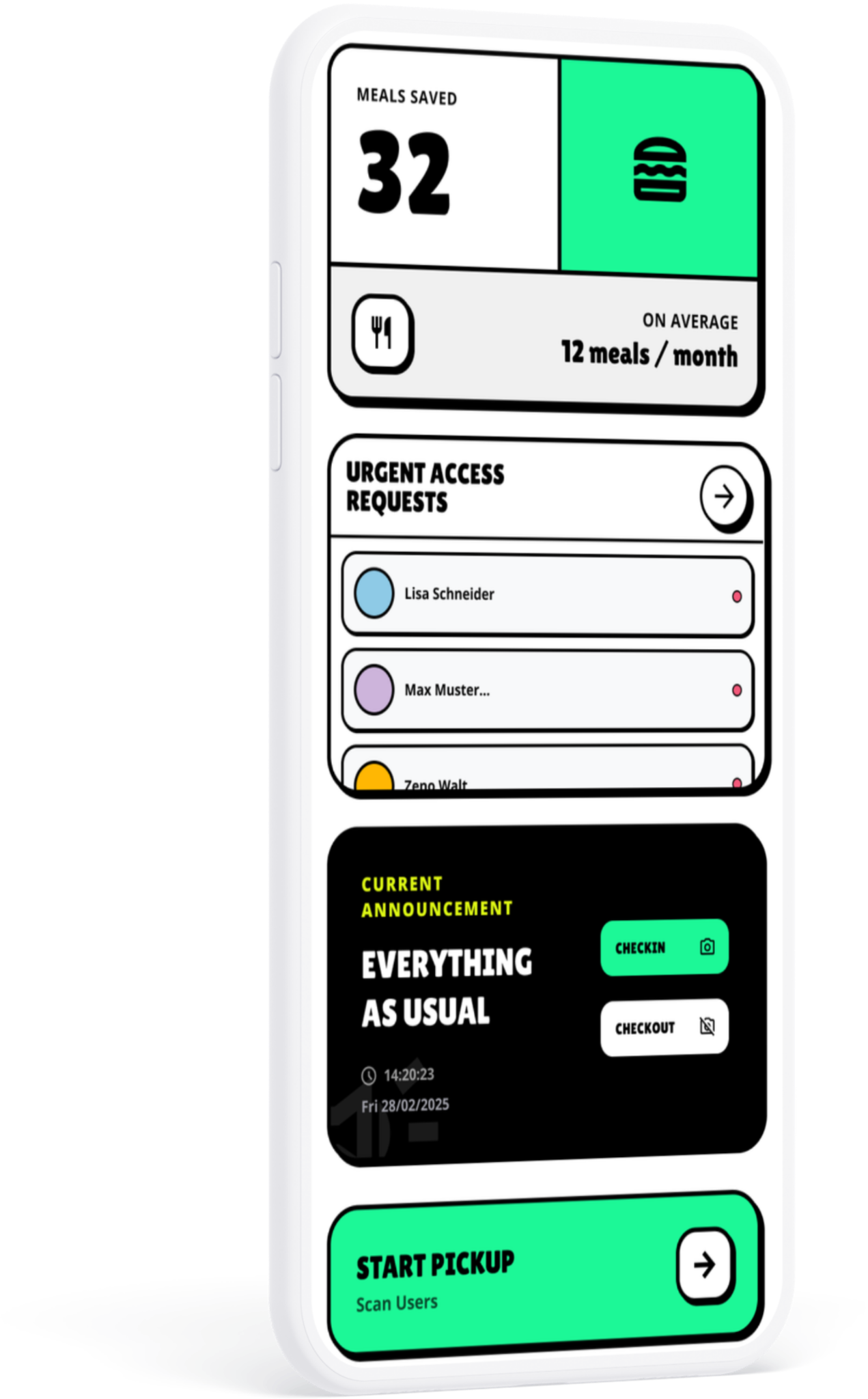
Manage access and collections digitally. Food decisions stay on site.
- Know who’s taking part
A registered group instead of open, unplanned collections.
- Collect at the agreed time
A set window after regular service makes the process clear.
- Track collections
Confirmation records the pickup. Measuring quantities is an additional step.
THE DASHBOARD
See what’s rescued. Understand what’s left.
Track confirmed collections and analyse quantities recorded separately. See what was redistributed and where a closer look at planning could help.
Confirmed collections and separately weighed quantities complement each other in the analysis.
Quantity redistributed
Quantities over time
Four weeks compared.
DATA WITH A PURPOSE
From leftover quantities to better production decisions.
Context makes a number useful: what was cooked, served, redistributed or discarded?
- Record
- Understand
- Analyse
- Adjust production
- Measure again
| Which data? | What does it show? | What else is needed? |
|---|---|---|
| Confirmed pickup | A documented collection. | A weight measurement for kilogram figures. |
| Weighed leftover quantity | The quantity at a defined measurement point. | Dish, time and a clear waste category. |
| Production and sales | The relationship between food prepared and food served. | Comparable periods and actual demand. |
| Calculated environmental impact | A result based on an explained methodology. | Suitable factors, system boundaries and robust input data. |
What an adjustment might look like: If demand changes during exams, compare equivalent academic weeks. Look at dishes and time windows as well as totals. Adjust an initial batch and measure again under similar conditions.
Compare redistribution, remaining waste and production volumes over similar periods. This shows whether adjusted planning actually leads to less overproduction.
Explore five food waste metricsGET STARTED TOGETHER
Introduce a process that fits your day.
We start with your schedules, responsibilities and routines. Together, we establish which food is suitable, who manages access and when pickup makes sense.
Responsibility for food safety and approval remains with the food business. Documented pickups replace neither hygiene checks nor independent waste measurement.
What we discuss first
- End of service, current surplus volumes and hygiene procedures.
- Responsible team members and the participant group.
- Pickup times, personal containers and digital confirmation.
- Which data is already available and what else should be collected.
FREQUENTLY ASKED QUESTIONS
What your team wants to know.
How much work is involved, and when do we receive compensation?
Additional serving time starts at five minutes a day. Your canteen receives fixed compensation before the agreed service period begins.
How can a university canteen reduce food waste?
Demand-led preparation, separate waste measurement and suitable portion sizes work together. For suitable surplus that remains, Food Be Good adds an organised collection process after service.
Can several university canteens take part?
Processes need to reflect each site’s schedules, responsibilities and available quantities. We agree the setup for each participating canteen together.
Is a particular menu available every day?
No. Only meals that are actually available and approved by the canteen are redistributed. Neither a specific dish nor daily availability is guaranteed.
How do we account for term breaks?
Record them in your measurements and compare similar operating periods. Don’t extrapolate a typical teaching week across the whole year without checking the assumptions.
What’s the difference between unserved food and plate waste?
Unserved food has not been handed to guests; plate waste comes back from guests. Record the categories separately. Redistribution always requires suitable food approved under the hygiene process.
THE NEXT STEP
Let’s get to know your site.
Tell us when service ends and how you currently handle suitable surplus. Together, we’ll explore a process that fits.
We start with a conversation. Availability and conditions are agreed individually.
Food Be Good for workplace canteens